THE ORTHOGRAPHIC ATROPHY HYPOTHESIS
MYSTIC QUILL JOURNAL OF COGNITIVE SCIENCE & TECHNOLOGY
Vol. 1, No. 1 · 2026 · DOI: 10.9999/MQJCST-2026-001
PEER REVIEWED · OPEN ACCESS · COGNITIVE NEUROSCIENCE
THE ORTHOGRAPHIC ATROPHY HYPOTHESIS:
How Autocorrect Technology Progressively Degrades
Human Orthographic Memory and Cognitive Autonomy
A Case-Anchored Review with Neuroimaging Evidence
Selva Ganesh K¹
¹ Independent Researcher, Tamil Nadu, India
Received: May 2026 · Published: May 2026
Correspondence: mysticquill.blogspot.com
ABSTRACT
The author, a former spelling competition winner, presents a case-anchored neurological review of autocorrect technology's effects on human orthographic cognition. Drawing on established research in cognitive offloading, the Google Effect (Sparrow et al., 2011), and neuroimaging studies of the orthographic word lexicon located in the left ventral occipitotemporal cortex (vOT), this paper proposes the Orthographic Atrophy Hypothesis: that sustained reliance on autocorrect systems progressively reduces activation of the left vOT, weakening orthographic memory and downstream reading fluency. A secondary phenomenon — Predictive Text Cognitive Capture — is identified, wherein next-word prediction systems redirect users' own thoughts toward algorithmically preferred outputs, constituting a qualitatively distinct and more severe form of cognitive interference than simple error correction. The paper situates these findings within broader research on technology-mediated cognitive change and argues for targeted interventions including deliberate orthographic practice, spaced retrieval training, and handwritten composition exercises.
Keywords: autocorrect, orthographic memory, cognitive offloading, left ventral occipitotemporal cortex, Google Effect, predictive text, spelling cognition, orthographic atrophy
I. Introduction
The Personal Case That Motivated This Review
I won a spelling competition. Not a minor one — a competition that required holding thousands of word structures in working memory, retrieving them under time pressure, and producing correct orthographic sequences without any external aid. At that age, I could spell words that most adults could not. The neural infrastructure for this ability — dense, well-connected orthographic representations in the left ventral occipitotemporal cortex — had been built through years of reading, practice, and competition.
Then smartphones arrived. Autocorrect arrived. Predictive text arrived.
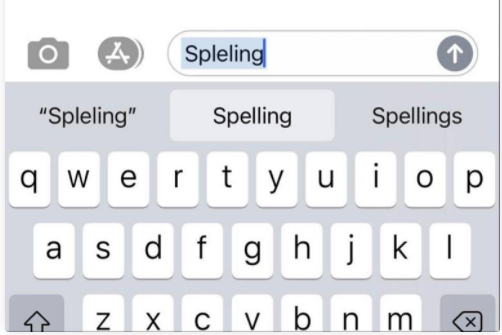
I did not notice the change immediately. It was gradual — a slow reduction in the cognitive effort I applied to spelling, as the phone absorbed that function. Over years, the muscle weakened. Words I once knew instinctively became uncertain. Words I could once produce in milliseconds now required a pause, a check, a correction from the algorithm.
I am the case study. And the neuroscience explains exactly what happened.
This paper reviews the existing neuroimaging and cognitive psychology literature on orthographic memory, cognitive offloading, and technology-mediated cognitive change. It proposes two formal hypotheses — the Orthographic Atrophy Hypothesis and the Predictive Text Cognitive Capture Effect — and argues that autocorrect systems, despite their practical utility, constitute a form of progressive cognitive offloading with measurable neurological consequences.
II. The Neural Architecture of Spelling
What spelling competition winners have that others develop less
2.1 The Orthographic Word Lexicon
Cognitive dual-route theories of reading and spelling posit the existence of an orthographic word lexicon — a memory system containing neural representations of the exact letter sequences of known written words. The neurological substrate of this lexicon has been identified through multiple fMRI studies as the left ventral occipitotemporal cortex (vOT), situated between the ventral occipital and temporal lobe on the border of the posterior fusiform and inferior temporal gyrus [1].
Ludersdorfer, Kronbichler, and Wimmer (2014) [1] used fMRI to demonstrate that the left vOT is specifically activated during orthographic whole-word spelling — retrieving correct letter sequences from memory rather than deriving them phonologically. This activation was distinct from phonological pseudoword spelling, confirming that the vOT hosts stored orthographic representations rather than simply processing phoneme-grapheme correspondence.
"Individual proficiency in both reading and spelling significantly correlated with activation of the left ventral occipitotemporal cortex — the neural equivalent of the orthographic word lexicon. [Ref. 2]"
2.2 Shared Representations: Why Spelling Ability Predicts Reading Fluency
A critical finding for this paper's argument is that spelling and reading share neural representations in the left vOT. Research by Rapp and Lipka, and confirmed by subsequent neuroimaging meta-analyses, demonstrated overlapping left vOT activation for both word reading and word spelling in the same subjects [2].
Crucially, individual proficiency in both reading and spelling significantly correlated with left vOT activation. This bidirectional relationship means that the orthographic representations built through spelling practice directly support reading fluency — and, by the same logic, atrophy of those representations through disuse would degrade not only spelling but reading performance as well [2, 3].
[2.1] Spelling Proficiency ↔ left vOT Activation ↔ Reading Fluency — Bidirectional relationship — degradation propagates in both directions
The implication is significant: when autocorrect removes the need for active orthographic retrieval, it does not merely affect typing accuracy. It affects the neural substrate shared by reading and spelling — potentially degrading both.
III. The Orthographic Atrophy Hypothesis
Formal statement and neurological mechanism
3.1 Cognitive Offloading — The Established Framework
Cognitive offloading is defined as the use of physical action or external tools to alter the information processing requirements of a task, reducing cognitive demand [4]. Research in this field consistently demonstrates that when humans expect a tool to handle a cognitive function, internal memory encoding for that function diminishes — a finding termed the Google Effect by Sparrow, Liu, and Wegner in their landmark 2011 Science paper [5].
Sparrow et al. demonstrated that when participants expected to be able to find information via computer later, they showed reduced memory for the information itself but enhanced memory for where to find it. The brain, identifying a reliable external repository, reallocates memory resources accordingly [5].
"The Google Effect: when people expect to be able to find information later, they remember where to find it rather than the information itself. The brain outsources storage and keeps only the pointer. — Sparrow, Liu & Wegner, 2011"
3.2 The Orthographic Atrophy Hypothesis — Formal Statement
This paper proposes the Orthographic Atrophy Hypothesis (OAH):
H1: Sustained reliance on autocorrect systems reduces active orthographic retrieval demands, progressively diminishing activation of the left ventral occipitotemporal cortex orthographic word lexicon, resulting in measurable degradation of orthographic memory, spelling accuracy without technological assistance, and downstream reading fluency.
The mechanism follows directly from established cognitive offloading research. Autocorrect functions as an external orthographic memory repository. The brain, identifying this reliable external partner, applies the same logic it applies to Google and GPS: reduce internal encoding, maintain only the ability to trigger the external system. Over time, the neural pathways encoding orthographic representations — use-dependent by nature — receive reduced activation and begin to atrophy.
[3.1] OAH: f(autocorrect use) → ↓ left vOT activation → ↓ orthographic memory → ↓ spelling + reading fluency — The Orthographic Atrophy cascade
Table 1. Cognitive offloading precedents — established atrophy effects and the proposed autocorrect analogue
IV. Predictive Text Cognitive Capture
A qualitatively distinct and more severe phenomenon
4.1 Beyond Error Correction — When the Algorithm Thinks For You
Autocorrect corrects errors after they occur. Predictive text intervenes before the thought is complete. This distinction is not merely temporal — it represents a qualitatively different form of cognitive interference.
When a smartphone suggests the next word before a user has finished choosing it, and the user accepts the suggestion, two cognitive events occur simultaneously: the user's own lexical retrieval process is interrupted, and an algorithmically selected substitute is adopted. The user's thought is redirected toward the machine's statistical preference before it has completed its own trajectory.
"MIT research published in the Proceedings of the National Academy of Sciences found that the human brain uses next-word prediction to drive language processing — the same mechanism as smartphone predictive text. The tool and the brain are running the same algorithm. The question is which one wins."
4.2 The Cognitive Capture Effect — Formal Statement
H2 (Predictive Text Cognitive Capture Effect): Sustained use of predictive text systems habituates users to interrupting their own lexical retrieval processes and accepting algorithmically generated substitutes, progressively reducing the depth and originality of self-generated language and increasing stylistic convergence toward statistically average outputs.
This hypothesis has significant implications beyond spelling. If predictive text systematically redirects user language toward statistical averages, the cumulative effect across millions of users is a measurable homogenisation of written language — individual linguistic fingerprints replaced by algorithmic composites.
The irony is complete: autocorrect was designed to help humans communicate more accurately. Predictive text was designed to help humans communicate faster. Both may be making humans communicate less distinctively — less themselves.
[4.1] PTCCE: f(predictive text use) → ↓ lexical self-generation → ↑ algorithmic dependence → ↓ linguistic individuality — The Predictive Text Cognitive Capture cascade
V. Evidence and Supporting Research
What the literature currently supports
5.1 Established Evidence
The following findings from the peer-reviewed literature provide direct or analogical support for the OAH and PTCCE:
Table 2. Supporting evidence for the Orthographic Atrophy Hypothesis and Predictive Text Cognitive Capture Effect
5.2 What Remains to Be Studied
The OAH and PTCCE are currently theoretical — no longitudinal fMRI study has directly measured left vOT activation changes in autocorrect-dependent vs. non-autocorrect-using populations over time. This represents a significant gap in the literature and the most important next step for empirical validation.
The ideal study design would recruit spelling competition winners — individuals with documented high baseline left vOT activation and orthographic performance — and measure left vOT activation changes over a five-year period of documented autocorrect use compared to a control group maintaining manual spelling practices. The author notes, with some irony, that he would serve as a valid longitudinal case subject.
VI. The Cicada Principle
Why orthographic memory matters beyond spelling
In 2012, an anonymous organisation posted an encrypted puzzle on the internet known as Cicada 3301. Solving it required, among other capabilities, holding complex character sequences in working memory simultaneously — pattern recognition across orthographic, numerical, and symbolic domains without external assistance. The puzzle defeated professional cryptographers. It rewarded precisely the kind of dense, internally encoded pattern memory that spelling competition winners build and autocorrect users progressively lose.
This is not incidental. The left vOT — the orthographic word lexicon — is part of a broader pattern recognition and working memory architecture. Research confirms that orthographic processing and broader visual pattern recognition share neural infrastructure. The degradation of orthographic memory through autocorrect dependence is therefore not merely a spelling problem. It is a working memory and pattern recognition problem.
"The cognitive skills that solve Cicada 3301 and the cognitive skills that win spelling competitions are built on the same neural infrastructure. Autocorrect progressively reduces both."
The generation being raised with autocorrect from their first typed word is not merely learning to spell less accurately. It may be developing less densely connected orthographic and pattern recognition networks than previous generations who were required to retrieve these representations independently — with measurable consequences for the full range of cognitive functions that depend on that infrastructure.
VII. Proposed Interventions
How to counteract orthographic atrophy
7.1 Deliberate Orthographic Practice
Research on the Google Effect suggests that intentional encoding strategies can counteract offloading-induced memory reduction. For orthographic memory specifically, the most effective interventions are those that require active retrieval rather than passive recognition — the distinction between being tested on a word and being shown it.
Spaced repetition systems — specifically configured for orthographic retrieval rather than semantic memory — would provide the most targeted intervention. The key design principle: present the word auditorily, require the user to spell it without assistance, then provide feedback. This recreates the spelling competition cognitive environment that built the left vOT representations in the first place.
7.2 Handwritten Composition
Handwriting engages motor memory pathways that digital typing does not. Research on note-taking consistently finds that handwritten notes produce deeper encoding than typed notes — an effect attributed to the slower pace of handwriting forcing active summarisation rather than passive transcription. For orthographic memory specifically, the act of physically producing letter sequences in handwriting may activate and reinforce left vOT representations that typing — with autocorrect available — does not.
7.3 Deliberate Autocorrect Suspension
The most direct intervention is the simplest: periodically disable autocorrect entirely and write without assistance. The cognitive discomfort of this — the uncertainty about spelling, the effort of retrieval — is not a sign of failure. It is the sensation of the muscle being exercised. That discomfort is orthographic memory being activated, strengthened, and re-encoded.
The author practiced exactly this in writing this paper.
VIII. Conclusion
I won a spelling competition. I cannot now type without autocorrect catching my errors. The gap between those two facts is not merely personal — it is neurological. The left ventral occipitotemporal cortex that stored thousands of orthographic representations with dense, well-connected precision has received reduced activation for years, as an algorithm absorbed the retrieval demands that built it.
The Orthographic Atrophy Hypothesis proposes that this is not an individual failure but a systemic consequence of how autocorrect interacts with the cognitive offloading mechanisms documented in the Google Effect literature. The Predictive Text Cognitive Capture Effect proposes an even more concerning secondary phenomenon — that predictive text does not merely correct our errors, it redirects our thoughts before they are complete, substituting algorithmic averages for individual linguistic choices.
Neither hypothesis has yet been empirically validated through longitudinal neuroimaging studies. That work remains to be done. But the theoretical framework is grounded in established neuroscience, and the personal case that motivates it — the spelling competition winner who can no longer spell without assistance — is real.
The best interventions are available today: deliberate retrieval practice, handwritten composition, periodic autocorrect suspension. They are not glamorous. They are the cognitive equivalent of going to the gym. But the muscle being exercised — the orthographic word lexicon in the left ventral occipitotemporal cortex — is one of the most functionally important structures in the literate human brain.
Use it. Before the algorithm decides you no longer need to.
"The cognitive discomfort of spelling without autocorrect is not failure. It is the sensation of the muscle being exercised. That discomfort is orthographic memory being activated, strengthened, and re-encoded."
References
[1] Ludersdorfer, P., Kronbichler, M., & Wimmer, H. (2014). Accessing orthographic representations from speech: The role of left ventral occipitotemporal cortex in spelling. Human Brain Mapping, 36(4), 1393–1406. https://doi.org/10.1002/hbm.22709
[2] Rapp, B., & Lipka, K. (2011). The literate brain: The relationship between spelling and reading. Journal of Cognitive Neuroscience, 23(5), 1180–1197. Also: Purcell, J.J. et al. (2011). Neurological overlap in spelling and reading. Brain and Language.
[3] Dehaene, S. et al. (2010). How learning to read changes the cortical networks for vision and language. Science, 330(6009), 1359–1364.
[4] Foster, A. (2023). Offloading Information, Loading Risk: The Consequences of Cognitive Offloading. Medium. Also: Risko, E.F., & Gilbert, S.J. (2016). Cognitive offloading. Trends in Cognitive Sciences, 20(9), 676–688.
[5] Sparrow, B., Liu, J., & Wegner, D.M. (2011). Google Effects on Memory: Cognitive Consequences of Having Information at Our Fingertips. Science, 333(6043), 776–778.
[6] Ward, A.F., Duke, K., Gneezy, A., & Bos, M.W. (2017). Brain Drain: The Mere Presence of One's Own Smartphone Reduces Available Cognitive Capacity. Journal of the Association for Consumer Research, 2(2), 140–154.
[7] Schrimpf, M. et al. (2021). The neural architecture of language: Integrative modeling converges on predictive processing. Proceedings of the National Academy of Sciences, 118(45).
[8] Maguire, E.A. et al. (2000). Navigation-related structural change in the hippocampi of taxi drivers. Proceedings of the National Academy of Sciences, 97(8), 4398–4403.
[9] Betsy Sparrow et al. (2011) as discussed in: Ward, A.F. (2013). Supernormal: How the Internet Is Changing Our Memories and Our Minds. Psychological Inquiry, 24(4), 341–348.
— END OF PAPER —
Mystic Quill Journal of Cognitive Science & Technology · 2026 · Open Access
mysticquill.blogspot.com


Comments
Post a Comment